
Thank you for Subscribing to Business Management Review Weekly Brief


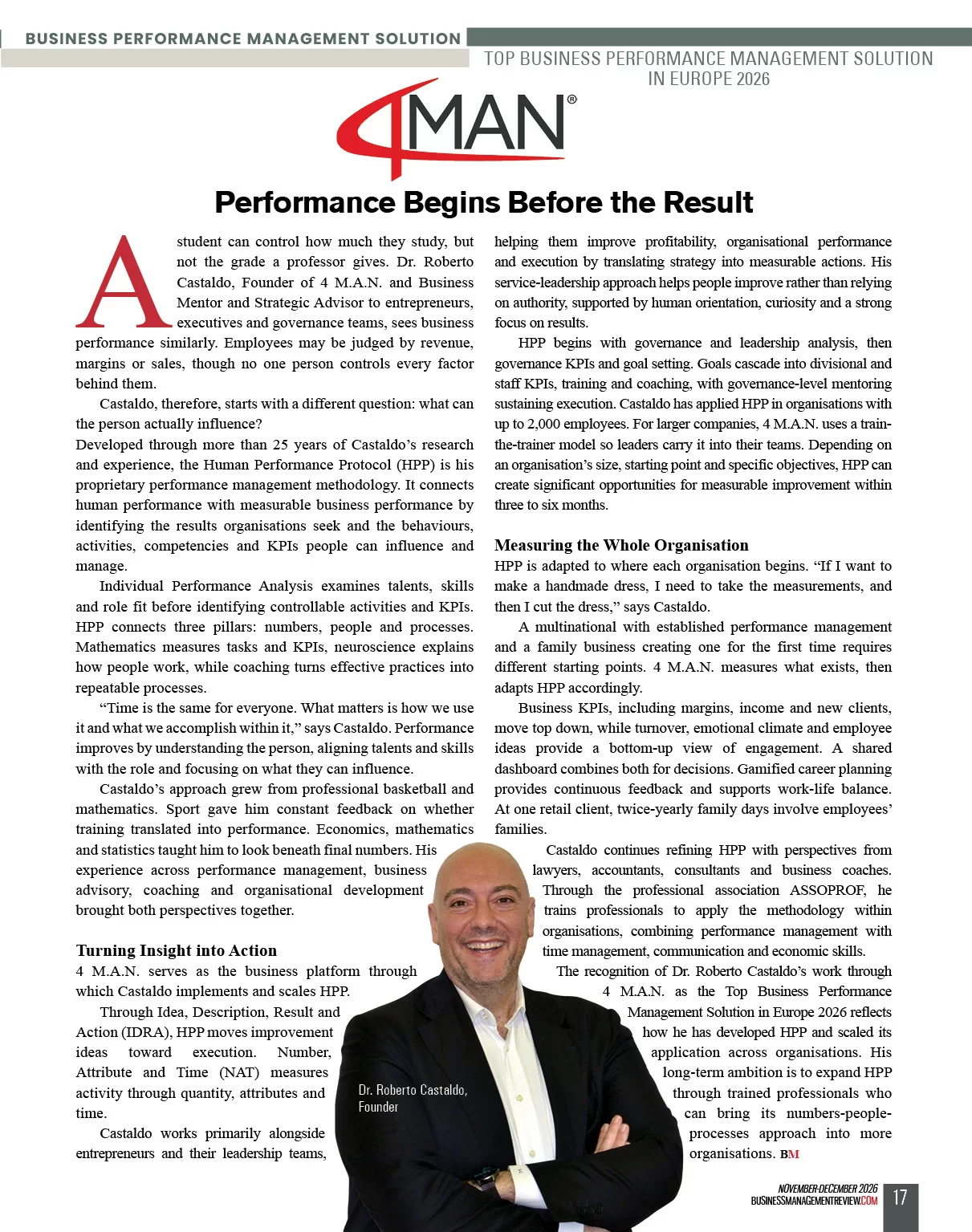
 Dr. Roberto Castaldo, Founder
Castaldo, therefore, starts with a different question: what can the person actually influence?
Developed through more than 25 years of Castaldo’s research and experience, the Human Performance Protocol (HPP) is his proprietary performance management methodology. It connects human performance with measurable business performance by identifying the results organisations seek and the behaviours, activities, competencies and KPIs people can influence and manage.
Individual Performance Analysis examines talents, skills and role fit before identifying controllable activities and KPIs. HPP connects three pillars: numbers, people and processes. Mathematics measures tasks and KPIs, neuroscience explains how people work, while coaching turns effective practices into repeatable processes.
“Time is the same for everyone. What matters is how we use it and what we accomplish within it,” says Castaldo. Performance improves by understanding the person, aligning talents and skills with the role and focusing on what they can influence.
Castaldo’s approach grew from professional basketball and mathematics. Sport gave him constant feedback on whether training translated into performance. Economics, mathematics and statistics taught him to look beneath final numbers. His experience across performance management, business advisory, coaching and organisational development brought both perspectives together.
Turning Insight into Action
4 M.A.N. serves as the business platform through which Castaldo implements and scales HPP.
Through Idea, Description, Result and Action (IDRA), HPP moves improvement ideas toward execution. Number, Attribute and Time (NAT) measures activity through quantity, attributes and time.
Castaldo works primarily alongside entrepreneurs and their leadership teams, helping them improve profitability, organisational performance and execution by translating strategy into measurable actions. His service-leadership approach helps people improve rather than relying on authority, supported by human orientation, curiosity and a strong focus on results.
-
Time is the same for everyone. What matters is how we use it and what we accomplish within it.
HPP begins with governance and leadership analysis, then governance KPIs and goal setting. Goals cascade into divisional and staff KPIs, training and coaching, with governance-level mentoring sustaining execution. Castaldo has applied HPP in organisations with up to 2,000 employees. For larger companies, 4 M.A.N. uses a train-the-trainer model so leaders carry it into their teams. Depending on an organisation’s size, starting point and specific objectives, HPP can create significant opportunities for measurable improvement within three to six months.
Measuring the Whole Organisation
HPP is adapted to where each organisation begins. “If I want to make a handmade dress, I need to take the measurements, and then I cut the dress,” says Castaldo.
A multinational with established performance management and a family business creating one for the first time requires different starting points. 4 M.A.N. measures what exists, then adapts HPP accordingly.
Business KPIs, including margins, income and new clients, move top down, while turnover, emotional climate and employee ideas provide a bottom-up view of engagement. A shared dashboard combines both for decisions. Gamified career planning provides continuous feedback and supports work-life balance. At one retail client, twice-yearly family days involve employees’ families.
Castaldo continues refining HPP with perspectives from lawyers, accountants, consultants and business coaches. Through the professional association ASSOPROF, he trains professionals to apply the methodology within organisations, combining performance management with time management, communication and economic skills.
The recognition of Dr. Roberto Castaldo’s work through 4 M.A.N. as the Top Business Performance Management Solution in Europe 2026 reflects how he has developed HPP and scaled its application across organisations. His long-term ambition is to expand HPP through trained professionals who can bring its numbers-people-processes approach into more organisations.
Performance Measures Managers Can Actually Influence
Performance reviews often arrive after the quarter has already exposed the problem. Revenue misses and margin erosion may be obvious, yet the numbers rarely tell managers which daily actions are within an employee’s control. That gap matters when executives are buying a business performance management solution. A system that mainly records end results can sharpen reporting while doing little to improve the work that produces those results. The more useful test is whether the approach turns broad goals into measurable activities that managers can influence before the next reporting cycle closes. The distinction becomes sharper when bonus decisions or staffing changes depend on the same measures.
Measurement design is where many programs lose credibility. Enterprise KPIs often sit too far from the individual role, leaving employees accountable for outcomes shaped by pricing decisions or market conditions. Better performance management connects company objectives to work that a person can reasonably own. Time use and task volume can be tracked directly. Quality needs a separate context to show whether higher output is actually useful. Measures also need clear ownership when one team’s output becomes another team’s input. The metric set must remain small enough for managers to interpret. A dense dashboard may look sophisticated while making weekly decisions slower.
“4 M.A.N.’s Human Performance Protocol links individual performance analysis with controllable KPIs, then carries that structure into governance reviews and staff goal setting.”
Role fit deserves equal scrutiny. Persistent underperformance can come from a poor match between a person’s skills and the work assigned rather than a lack of effort. Leadership behaviour can compound the issue when managers treat targets as instructions instead of feedback tools. Buyers should look for a method that can distinguish a coaching need from a role-design problem. It should also expose whether the process around the employee makes the expected result realistic. A useful assessment should show whether expectations exceed the authority attached to the role. That diagnostic discipline keeps performance conversations tied to evidence instead of managerial instinct.
Sustained use is the harder purchasing question. Initial goal-setting workshops can create activity without changing management habits. A credible solution should establish a repeatable review cadence and make relevant performance data visible. Managers also need a practical way to adjust expectations when conditions change. Adoption depends on whether the model can move beyond outside consultants. Executives should test what happens after the adviser leaves and whether review routines remain usable without specialist support. Internal leaders need enough structure to coach employees and carry the method into larger teams without turning every review into a specialist exercise. Feedback should reach the employee close enough to the work to affect the next decision, not months later during an annual appraisal.
4 M.A.N. is a strong fit for executives who want performance management anchored in controllable work rather than retrospective scoring. Its Human Performance Protocol links individual performance analysis with controllable KPIs, then carries that structure into governance reviews and staff goal setting. The method uses IDRA to move ideas towards defined actions and NAT to make those actions measurable through a numerical target and a time-bound attribute. Coaching supports the management process, while dashboards give teams current performance information for decision-making. The model can also be extended through a train-the-trainer approach for larger organisations. For buyers who need measurable accountability without separating people from the work design around them, 4 M.A.N. merits serious consideration.
...Read more
Business Performance Management Solutions in Europe Info
Q1
What Are Business Performance Management Solutions In Europe?
Business Performance Management Solutions In Europe help organizations connect strategic goals with measurable activities, performance indicators and management routines. Rather than looking only at revenue, margins or other end results, an effective approach also examines the work that contributes to those outcomes. The goal is to make performance easier to manage through aligned KPIs, clear ownership, review processes and actionable feedback. For organizations, the value lies in creating a consistent link between strategy, people, processes and measurable execution.
Q2
How Does 4 M.A.N. Approach Business Performance Management?
4 M.A.N. applies its Human Performance Protocol (HPP), a methodology developed through Dr. Roberto Castaldo’s more than 25 years of research and experience. HPP connects numbers, people and processes by identifying organizational results alongside the behaviours, activities, competencies and KPIs that individuals can influence. Its Individual Performance Analysis considers talents, skills and role fit before establishing controllable activities and measures. The approach therefore treats Business Performance Management Solutions In Europe as a management discipline that links human performance to business performance.
Q3
What Capabilities Should Business Performance Management Programs Include?
Useful Business Performance Management Solutions In Europe should translate broad organizational objectives into measures that people can reasonably influence. Capabilities can include governance and leadership analysis, goal setting, KPI cascades, performance dashboards, training, coaching and review processes. Measurement should also distinguish quantity, quality and time rather than relying on a single output figure. In 4 M.A.N.’s HPP, the NAT framework measures activity through Number, Attribute and Time, while IDRA moves ideas through Idea, Description, Result and Action toward execution.
Q4
How Can Business Performance Management Improve Execution?
Business Performance Management Solutions In Europe can strengthen execution when performance measures reach the level of daily work. HPP begins with governance and leadership analysis before moving through governance KPIs, divisional and staff KPIs, training and coaching. A shared dashboard can bring top-down indicators such as margins, income and new clients together with bottom-up signals including turnover, emotional climate and employee ideas. This creates a broader view of performance and gives managers information they can use before problems become purely retrospective results.
Q5
What Should Organizations Consider When Evaluating Performance Management Programs?
Organizations evaluating Business Performance Management Solutions In Europe should examine whether the methodology fits their existing performance-management maturity, organizational size and objectives. A multinational with established systems may need a different starting point from a family business creating a framework for the first time. HPP is adapted to what already exists, with measurable improvement opportunities potentially emerging within three to six months depending on the organization’s starting point and objectives. The ability to sustain the method internally also matters, particularly where larger organizations require a train-the-trainer model.
Q6
How Is 4 M.A.N. Extending Performance Management In Europe?
4 M.A.N. extends Business Performance Management Solutions In Europe through a model designed to move beyond external intervention. HPP has been applied in organizations with up to 2,000 employees, while larger organizations can use trained leaders to carry the methodology into their teams. Castaldo also works with professionals through ASSOPROF, where training combines performance management with time management, communication and economic skills. The model positions performance management around measurable work, repeatable processes and the relationship between numbers, people and processes.
Company :
4 M.A.N.
ManagementDr. Roberto Castaldo, Founder
Description
4 M.A.N. is the business platform through which Dr. Roberto Castaldo helps entrepreneurs, executives and governance teams improve measurable business performance. Through his proprietary Human Performance Protocol (HPP), he integrates numbers, people and processes to translate strategy into execution and measurable and lasting organisational performance.