

Thank you for Subscribing to Business Management Review Weekly Brief


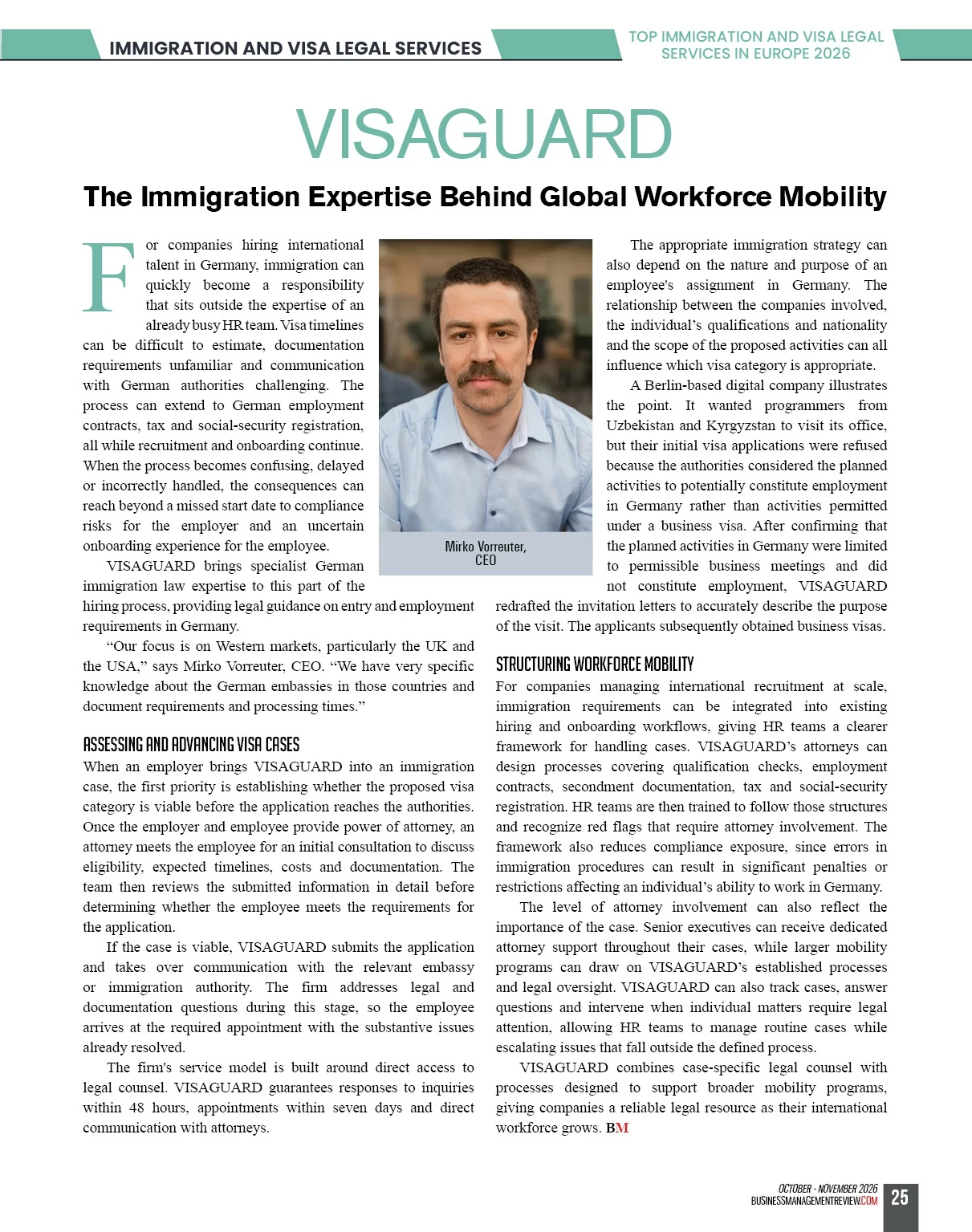
 Mirko Vorreuter, CEO For companies hiring international talent in Germany, immigration can quickly become a responsibility that sits outside the expertise of an already busy HR team. Visa timelines can be difficult to estimate, documentation requirements unfamiliar and communication with German authorities challenging. The process can extend to German employment contracts, tax and social-security registration, all while recruitment and onboarding continue. When the process becomes confusing, delayed or incorrectly handled, the consequences can reach beyond a missed start date to compliance risks for the employer and an uncertain onboarding experience for the employee.
Company :
Management
Mirko Vorreuter, CEO
![]()
Mirko Vorreuter, CEOVISAGUARD brings specialist German immigration law expertise to this part of the hiring process, providing legal guidance on entry and employment requirements in Germany.
“Our focus is on Western markets, particularly the UK and the USA,” says Mirko Vorreuter, CEO. “We have very specific knowledge about the German embassies in those countries and document requirements and processing times.”
Assessing and Advancing Visa Cases
When an employer brings VISAGUARD into an immigration case, the first priority is establishing whether the proposed visa category is viable before the application reaches the authorities. Once the employer and employee provide power of attorney, an attorney meets the employee for an initial consultation to discuss eligibility, expected timelines, costs and documentation. The team then reviews the submitted information in detail before determining whether the employee meets the requirements for the application.
If the case is viable, VISAGUARD submits the application and takes over communication with the relevant embassy or immigration authority. The firm addresses legal and documentation questions during this stage, so the employee arrives at the required appointment with the substantive issues already resolved.
-
Our focus is on Western markets, particularly the UK and the USA. We have very specific knowledge about the German embassies in those countries and document requirements and processing times.
The firm's service model is built around direct access to legal counsel. VISAGUARD guarantees responses to inquiries within 48 hours, appointments within seven days and direct communication with attorneys.
The appropriate immigration strategy can also depend on the nature and purpose of an employee's assignment in Germany. The relationship between the companies involved, the individual’s qualifications and nationality and the scope of the proposed activities can all influence which visa category is appropriate.
A Berlin-based digital company illustrates the point. It wanted programmers from Uzbekistan and Kyrgyzstan to visit its office, but their initial visa applications were refused because the authorities considered the planned activities to potentially constitute employment in Germany rather than activities permitted under a business visa. After confirming that the planned activities in Germany were limited to permissible business meetings and did not constitute employment, VISAGUARD redrafted the invitation letters to accurately describe the purpose of the visit. The applicants subsequently obtained business visas.
Structuring Workforce Mobility
For companies managing international recruitment at scale, immigration requirements can be integrated into existing hiring and onboarding workflows, giving HR teams a clearer framework for handling cases. VISAGUARD’s attorneys can design processes covering qualification checks, employment contracts, secondment documentation, tax and social-security registration. HR teams are then trained to follow those structures and recognize red flags that require attorney involvement. The framework also reduces compliance exposure, since errors in immigration procedures can result in significant penalties or restrictions affecting an individual’s ability to work in Germany.
The level of attorney involvement can also reflect the importance of the case. Senior executives can receive dedicated attorney support throughout their cases, while larger mobility programs can draw on VISAGUARD’s established processes and legal oversight. VISAGUARD can also track cases, answer questions and intervene when individual matters require legal attention, allowing HR teams to manage routine cases while escalating issues that fall outside the defined process.
VISAGUARD combines case-specific legal counsel with processes designed to support broader mobility programs, giving companies a reliable legal resource as their international workforce grows.
Managing Cross-Border Immigration through Process Control
Cross-border hiring can begin to unravel before an employee reaches a consulate. Recruitment may approve a start date while visa eligibility is unresolved, and HR can discover too late that local employment documents are incomplete. Authority correspondence then sits outside the normal onboarding sequence. For executives, the concern is not merely whether counsel can file an application. It is whether immigration work can be made predictable enough to support hiring decisions without exposing the company to avoidable delay or compliance errors.
Early legal assessment becomes a central buying issue. Counsel should be able to identify the appropriate route and test eligibility before submission. It should also turn document requirements into a sequence HR can actually follow. Timing estimates need similar discipline because relocation plans and project staffing may depend on them. The work also has to account for differences between routine transfers and cases shaped by unusual employee circumstances. A provider that treats every filing as a stand-alone matter can resolve individual cases yet leave the employer rebuilding the process each time.
Legal expertise is more useful when it reaches into the employer’s own workflow. International assignments can involve employment documentation and social security registration while immigration authorities impose separate filing duties. Effective counsel should know where those requirements intersect recruitment and onboarding, then establish repeatable controls without forcing every employee through an identical path. Nationality, qualifications, salary and the employer’s local presence can alter the route. Buyers should therefore look for a model that standardizes recurring work but still allows detailed attorney review when the facts change.
“VISAGUARD can also build HR workflows for recurring transfers and provide closer attorney supervision for senior employees.”
Service access can become decisive once a case moves outside the expected path. A document request from an embassy or a delay at a local authority can quickly affect a planned start date. Too many handoffs between intake staff and lawyers create another source of uncertainty. Direct attorney communication and clear responsibility for authority correspondence help shorten that gap. Senior hires may justify close case supervision, while larger transfer programs need a model based on shared workflows and recurring case reviews rather than individualized handling for every employee.
Scale introduces a different test. Repeated immigration work should leave HR better able to manage the next case rather than permanently dependent on outside counsel for routine steps. Training can help internal teams check qualifications and recognize warning signs before a filing is underway. Routine matters can then follow an established process, leaving counsel to handle exceptions and disputed requirements. Separating routine handling from legal escalation gives employers more control over recurring transfers without asking HR to become an immigration law function.
Against those requirements, VISAGUARD stands out as a premier choice for employers managing German immigration within broader European mobility programs. It provides direct attorney access and end-to-end visa representation. Its representation covers eligibility review and document checking, while its lawyers handle authority communication and filing steps. VISAGUARD can also build HR workflows for recurring transfers and provide closer attorney supervision for senior employees. Regular training supports internal teams that handle standard cases, while its lawyers can step in when a matter becomes more complex. For buyers that need German visa expertise tied closely to recruitment and mobility processes, that service structure warrants serious consideration.
...Read more
Immigration and Visa Legal Services in Europe Info
Q1
What Do Immigration and Visa Legal Services in Europe Typically Cover?
Immigration and Visa Legal Services in Europe help organizations and international professionals handle the legal steps tied to cross-border hiring, assignments and employment. The work can include choosing the right visa route, preparing documents, checking eligibility, communicating with authorities and addressing compliance requirements. For employers, that legal support can also connect immigration work with recruitment and onboarding. Clearer guidance at each stage helps reduce avoidable delays and gives applicants a better understanding of what is expected before a case moves forward.
Q2
How Does VISAGUARD Support Employers Managing German Immigration Cases?
VISAGUARD delivers Immigration and Visa Legal Services in Europe through a practice focused on German immigration law. Its attorneys assess whether a proposed visa route is workable before filing, hold an initial legal consultation with the applicant and review supporting documents in detail. If the case proceeds, the firm can submit the application and communicate with the relevant embassy or immigration authority. VISAGUARD also gives clients direct access to attorneys, supported by defined response and appointment timeframes for questions that need legal attention.
Q3
Why Does Early Visa Eligibility Assessment Matter for International Hiring?
Before an application is received by an authority, it can be expedient to start with eligibility. Immigration and Visa Legal Services in Europe can help determine whether an applicant's nationality, work status, qualifications, and planned activities align with the selected visa path. Additionally, missing documentation may be found early enough to be corrected thanks to that review. Better planning regarding start dates, onboarding, and compliance is a practical advantage for hiring teams as opposed to finding a mismatch after the process has already begun.
Q4
What Should Buyers Evaluate in Immigration and Visa Legal Services in Europe?
Organizations should look beyond application filing. Immigration and Visa Legal Services in Europe are more useful when legal advisers can explain available visa options, review documentation closely, communicate with authorities and spot compliance issues before they disrupt a case. Access to qualified legal counsel also matters when a question could affect a planned start date or cross-border assignment. Buyers should consider whether the provider can support individual cases while also helping employers establish repeatable immigration processes for ongoing workforce mobility.
Q5
How Does VISAGUARD Help Structure Workforce Mobility Processes?
VISAGUARD extends Immigration and Visa Legal Services in Europe beyond individual applications by helping employers build immigration procedures into hiring and onboarding workflows. Its attorneys can structure processes involving qualification reviews, employment documents, secondment paperwork, tax registration and social-security registration. The firm can also train HR teams to follow those procedures and recognize when a matter needs legal escalation. Routine cases can then move through an established framework while more complex questions receive direct attorney attention.
Q6
How Can Legal Immigration Support Reduce Compliance and Hiring Risk?
Cross-border hiring can create problems when visa categories, documentation or employment conditions are misunderstood. Immigration and Visa Legal Services in Europe reduce that exposure by tying immigration decisions to the facts of the assignment and the employer’s responsibilities. Careful legal review can catch filing errors, clarify communication with authorities and make onboarding more predictable. For organizations handling international recruitment repeatedly, consistent procedures can also reduce confusing handoffs and make it easier to identify cases that need specialist legal review.
Company :
VISAGUARD
ManagementMirko Vorreuter, CEO
Description
VISAGUARD is a German visa and immigration law specialist supporting employers, international professionals and businesses with immigration, workforce mobility and cross-border assignments. It combines legal expertise with hands-on case management, helping clients navigate visa requirements, documentation, compliance processes and communication with German immigration authorities.
