
Thank you for Subscribing to Business Management Review Weekly Brief


 Nathan E. Hessler, Esq., Managing Partner How does integrating legal insight influence strategic business decision-making and long-term stability?
Fractional general counsel services follow the same connective structure. Business owners often face legal issues without clarity on which discipline is required. The firm serves as a coordinating layer across employment, litigation and regulatory matters, engaging outside specialists such as securities counsel when necessary. Lawyers are not interchangeable, and proper alignment of expertise protects both cost discipline and strategic direction.
Company :
Management
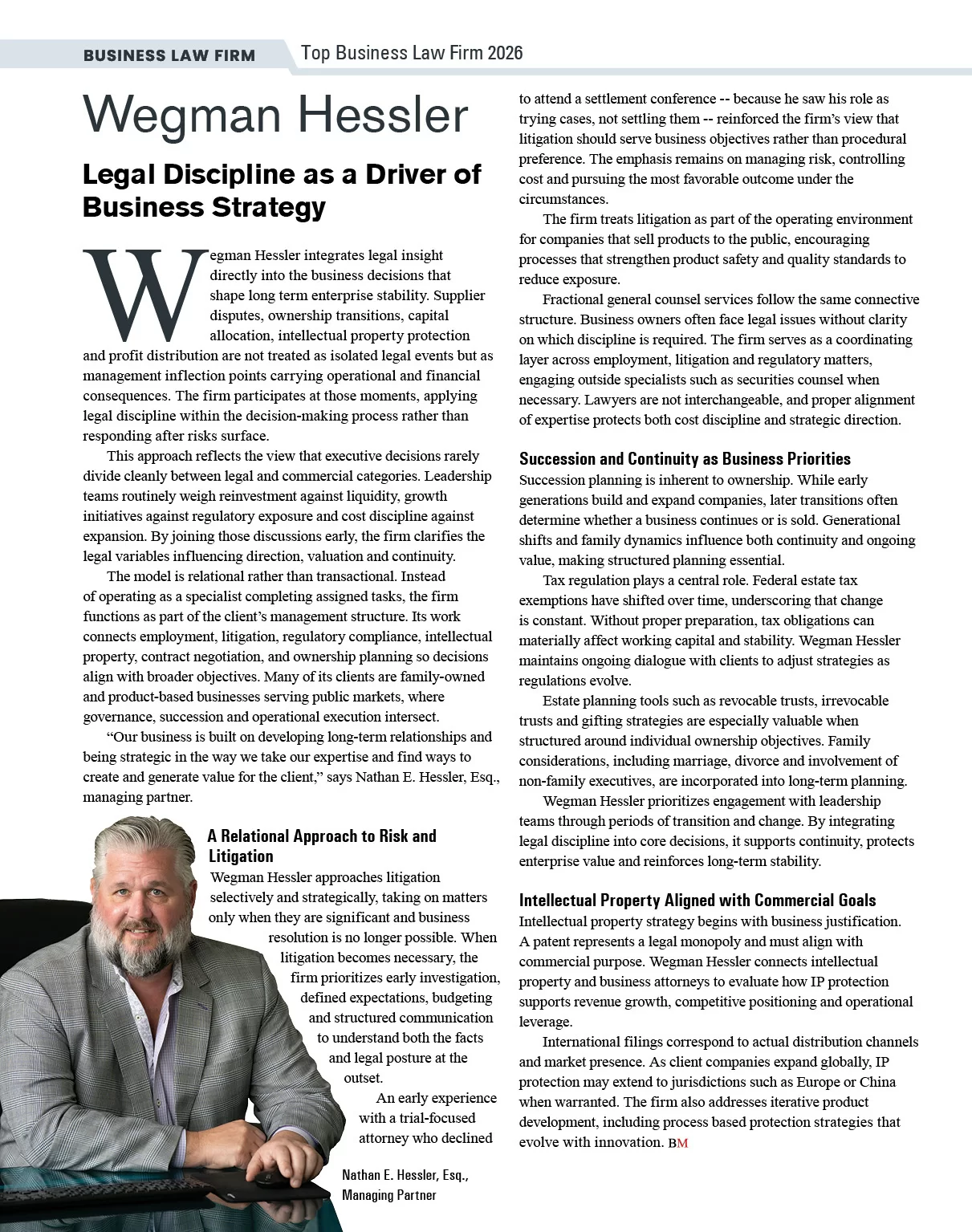
Nathan E. Hessler, Esq., Managing Partner
![]()
Nathan E. Hessler, Esq., Managing PartnerWegman Hessler integrates legal insight directly into the business decisions that shape long term enterprise stability. Supplier disputes, ownership transitions, capital allocation, intellectual property protection and profit distribution are not treated as isolated legal events but as management inflection points carrying operational and financial consequences. The firm participates at those moments, applying legal discipline within the decision-making process rather than responding after risks surface.
This approach reflects the view that executive decisions rarely divide cleanly between legal and commercial categories. Leadership teams routinely weigh reinvestment against liquidity, growth initiatives against regulatory exposure and cost discipline against expansion. By joining those discussions early, the firm clarifies the legal variables influencing direction, valuation and continuity.
The model is relational rather than transactional. Instead of operating as a specialist completing assigned tasks, the firm functions as part of the client’s management structure. Its work connects employment, litigation, regulatory compliance, intellectual property, contract negotiation, and ownership planning so decisions align with broader objectives. Many of its clients are family-owned and product-based businesses serving public markets, where governance, succession and operational execution intersect.
“Our business is built on developing long-term relationships and being strategic in the way we take our expertise and find ways to create and generate value for the client,” says Nathan E. Hessler, Esq., managing partner.
A Relational Approach to Risk and Litigation
Why does the firm approach litigation selectively within broader business risk management strategies?
Wegman Hessler approaches litigation selectively and strategically, taking on matters only when they are significant and business resolution is no longer possible. When litigation becomes necessary, the firm prioritizes early investigation, defined expectations, budgeting and structured communication to understand both the facts and legal posture at the outset.
An early experience with a trial-focused attorney who declined to attend a settlement conference -- because he saw his role as trying cases, not settling them -- reinforced the firm's view that litigation should serve business objectives rather than procedural preference. The emphasis remains on managing risk, controlling cost and pursuing the most favorable outcome under the circumstances.
The firm treats litigation as part of the operating environment for companies that sell products to the public, encouraging processes that strengthen product safety and quality standards to reduce exposure.
-
Our business is built on developing long-term relationships and being strategic in the way we take our expertise and find ways to create and generate value for the client.
Fractional general counsel services follow the same connective structure. Business owners often face legal issues without clarity on which discipline is required. The firm serves as a coordinating layer across employment, litigation and regulatory matters, engaging outside specialists such as securities counsel when necessary. Lawyers are not interchangeable, and proper alignment of expertise protects both cost discipline and strategic direction.
Succession and Continuity as Business Priorities
How do succession planning and tax regulations impact long-term business continuity and ownership transitions?
Succession planning is inherent to ownership. While early generations build and expand companies, later transitions often determine whether a business continues or is sold. Generational shifts and family dynamics influence both continuity and ongoing value, making structured planning essential.
Tax regulation plays a central role. Federal estate tax exemptions have shifted over time, underscoring that change is constant. Without proper preparation, tax obligations can materially affect working capital and stability. Wegman Hessler maintains ongoing dialogue with clients to adjust strategies as regulations evolve.
Estate planning tools such as revocable trusts, irrevocable trusts and gifting strategies are especially valuable when structured around individual ownership objectives. Family considerations, including marriage, divorce and involvement of non-family executives, are incorporated into long-term planning.
Wegman Hessler prioritizes engagement with leadership teams through periods of transition and change. By integrating legal discipline into core decisions, it supports continuity, protects enterprise value and reinforces long-term stability.
Intellectual Property Aligned with Commercial Goals
How does intellectual property strategy align with commercial objectives and global market expansion decisions?
Intellectual property strategy begins with business justification. A patent represents a legal monopoly and must align with commercial purpose. Wegman Hessler connects intellectual property and business attorneys to evaluate how IP protection supports revenue growth, competitive positioning and operational leverage.
International filings correspond to actual distribution channels and market presence. As client companies expand globally, IP protection may extend to jurisdictions such as Europe or China when warranted. The firm also addresses iterative product development, including process based protection strategies that evolve with innovation.
Strategic Legal Partnership for Modern Business Leadership
Business leaders rarely engage legal counsel simply to complete a transaction or resolve a dispute. Most seek guidance that helps them make decisions with long-term implications for growth, governance and risk. The modern business law firm therefore occupies a role closer to a strategic adviser than a technical service provider. Executives evaluating outside counsel tend to favor firms that understand how legal considerations intersect with operational decisions, financial planning and competitive strategy.
A central expectation is that legal insight should contribute directly to business problem-solving. Companies increasingly want advisers who participate in the reasoning behind decisions rather than appearing only when documents must be drafted or disputes arise. Effective counsel translates legal complexity into practical guidance that supports management teams as they weigh risk against opportunity. This approach demands lawyers who understand how contracts, regulations, ownership structures and intellectual property interact with the everyday realities of running a company.
Dispute management illustrates this shift clearly. Litigation remains a reality of commercial life, yet executives generally regard it as a costly and uncertain method of resolving conflict. Firms that demonstrate discipline in investigating disputes early, assessing legal exposure and identifying practical paths to resolution often provide greater value than those focused primarily on courtroom victories. Businesses benefit when their advisers maintain clear communication, establish cost expectations and treat litigation as one tool within a broader strategy rather than as the default path.
Ownership transition introduces another dimension where strategic legal guidance becomes essential. Many companies eventually face generational succession, partner exits or ownership restructuring. Navigating these moments demands careful alignment between legal planning, tax considerations and family dynamics. A thoughtful succession plan typically integrates estate structures, governance agreements and long-term tax strategy so that ownership transfers do not disrupt the continuity of the enterprise. Companies that address these issues early tend to protect both operational stability and accumulated wealth.
Another development influencing legal procurement is the demand for flexible access to counsel. Businesses often need ongoing guidance but cannot justify maintaining a full in-house legal department. Fractional general counsel arrangements have emerged as a practical alternative, providing consistent oversight without permanent staffing commitments. This model allows companies to obtain coordinated legal advice while drawing on specialized expertise when needed.
Intellectual property planning further highlights the need for integrated thinking. Patents, trademarks and related protections are valuable only when tied to clear commercial objectives. Companies benefit when legal advisers examine how intellectual property fits within broader product strategy, market expansion and competitive positioning. Protection across multiple jurisdictions, licensing decisions and process improvements all require coordination between legal analysis and business planning.
Wegman Hessler illustrates how this integrated perspective can translate into practical service for business leaders. The firm approaches its work by embedding legal discipline within the client’s broader management process rather than treating each matter as a standalone task. Its attorneys emphasize long-term relationships, guiding companies through disputes, intellectual property strategy, succession planning and ongoing legal oversight with a focus on aligning legal solutions with business objectives. The firm also offers fractional general counsel services that help organizations coordinate specialized legal expertise while maintaining consistent strategic guidance. This combination of broad experience, collaborative problem-solving and disciplined cost awareness positions Wegman Hessler as a compelling choice for executives seeking legal counsel that supports sustained business growth.
...Read more
Company :
Wegman Hessler
Management Nathan E. Hessler, Esq., Managing Partner
Description
Wegman Hessler is a strategic business law firm based in Cleveland that integrates legal discipline into making better business decisions. Through relationship-driven counsel, proactive litigation management, succession planning, IP strategy, and fractional general counsel services, the firm helps businesses mitigate risk and create long term value.
